Connection rates rarely collapse. They slide — a point here, a point there — until a team that used to book eight conversations a day books four and nobody can say exactly when it changed. The cause is almost always maintenance that quietly stopped happening.
Here is the routine worth running every month.
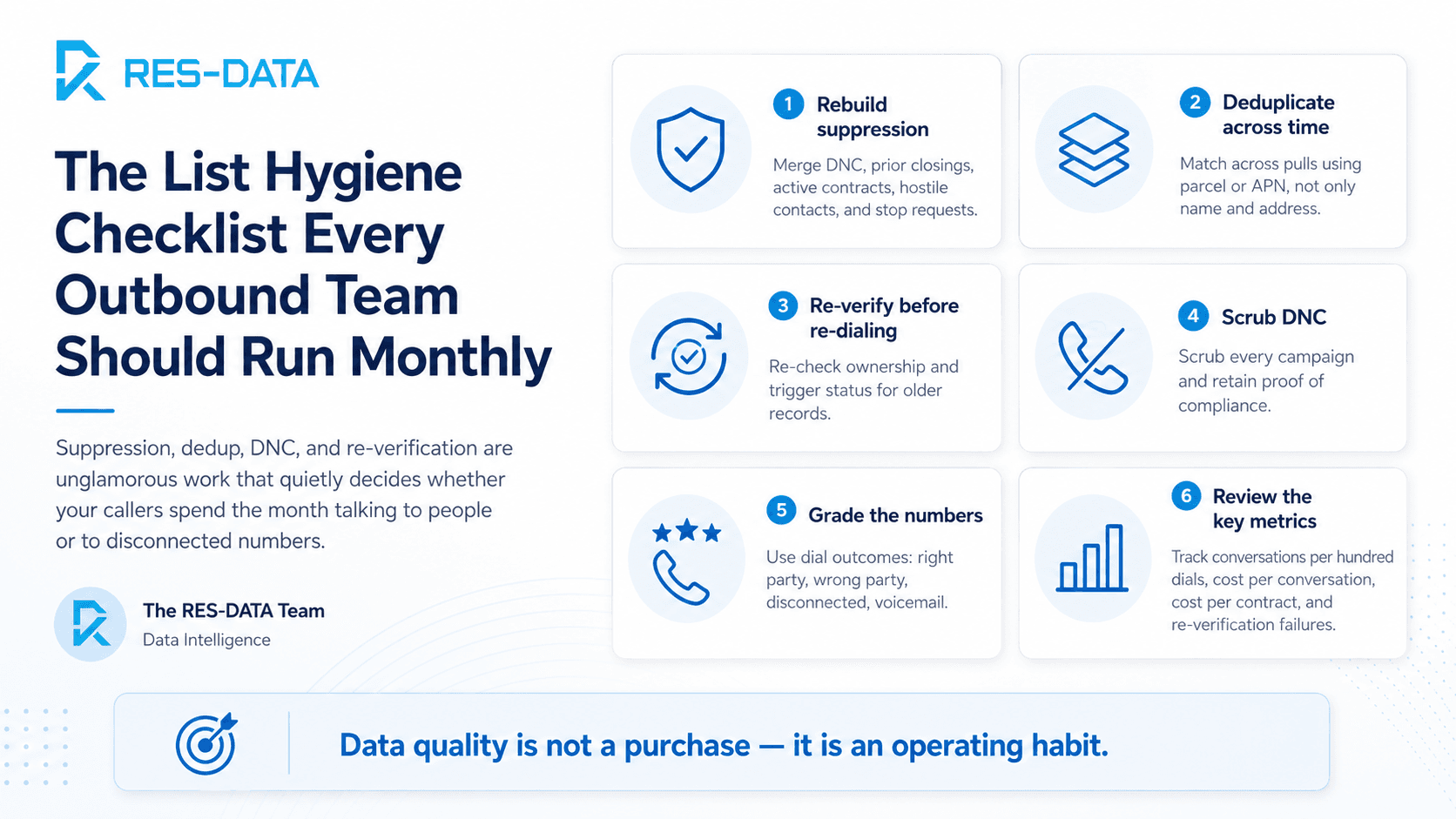
1. Rebuild suppression from every source
Suppression is not one list. It is do-not-calls, prior closings, active contracts, hostile contacts, litigious flags, and anyone who asked you to stop. These live in different systems and drift apart fast.
Pull them into a single suppression file monthly and apply it to every pull, including the ones from providers who claim to handle it. Trust but verify — this is the cheapest possible insurance.
2. Deduplicate across time, not just within the file
Deduping the file you just downloaded is table stakes. The expensive duplicates are across pulls: the same owner surfacing in three separate campaigns under slightly different name spellings or a mailing address instead of a property address.
Match on parcel or APN where you can, not just name and address strings. Names are messy; parcels are not.
3. Re-verify before re-dialing
Anything older than roughly 90 days should be re-checked before it goes back into rotation — ownership first, then the trigger that made it interesting. Records that fail either check should leave the active pool rather than quietly consuming dial time.
4. Scrub DNC and keep the record
Run current DNC scrubbing on every campaign and retain proof of when you did it. Compliance posture is not just about avoiding penalties; documented scrubbing is what lets you move fast without arguing about it later. If you are texting as well as calling, the messaging rules are their own discipline — treat them separately.
5. Grade the numbers you already have
Every dial produces a signal: right party, wrong party, disconnected, voicemail, no answer. Most teams collect this and never use it. Feed those outcomes back into the record so a phone that has been wrong-party twice stops getting called a third time.
This one change frees more agent hours than almost anything else on the list, and it costs nothing but the discipline to log outcomes consistently.
6. Review the numbers that matter
Close the month by looking at four figures: conversations per hundred dials, cost per conversation, cost per contract, and the share of records that failed re-verification. That last number is your data supplier's report card. If it climbs two months running, the problem is upstream of your team.
The point of the routine
None of this is clever. It is maintenance, and it is the reason two teams with identical scripts and identical headcount can produce completely different months. Data quality is not a purchase — it is an operating habit, and the teams that treat it that way stop having mysterious slow quarters.