Every wholesaler has had this week: you buy a fresh list of motivated sellers, load it into the dialer, and burn three days of agent time to find one person who is actually thinking about selling. The instinct is to blame the callers or the script. Usually the problem arrived before anyone picked up the phone.
A list is a photograph, not a live feed
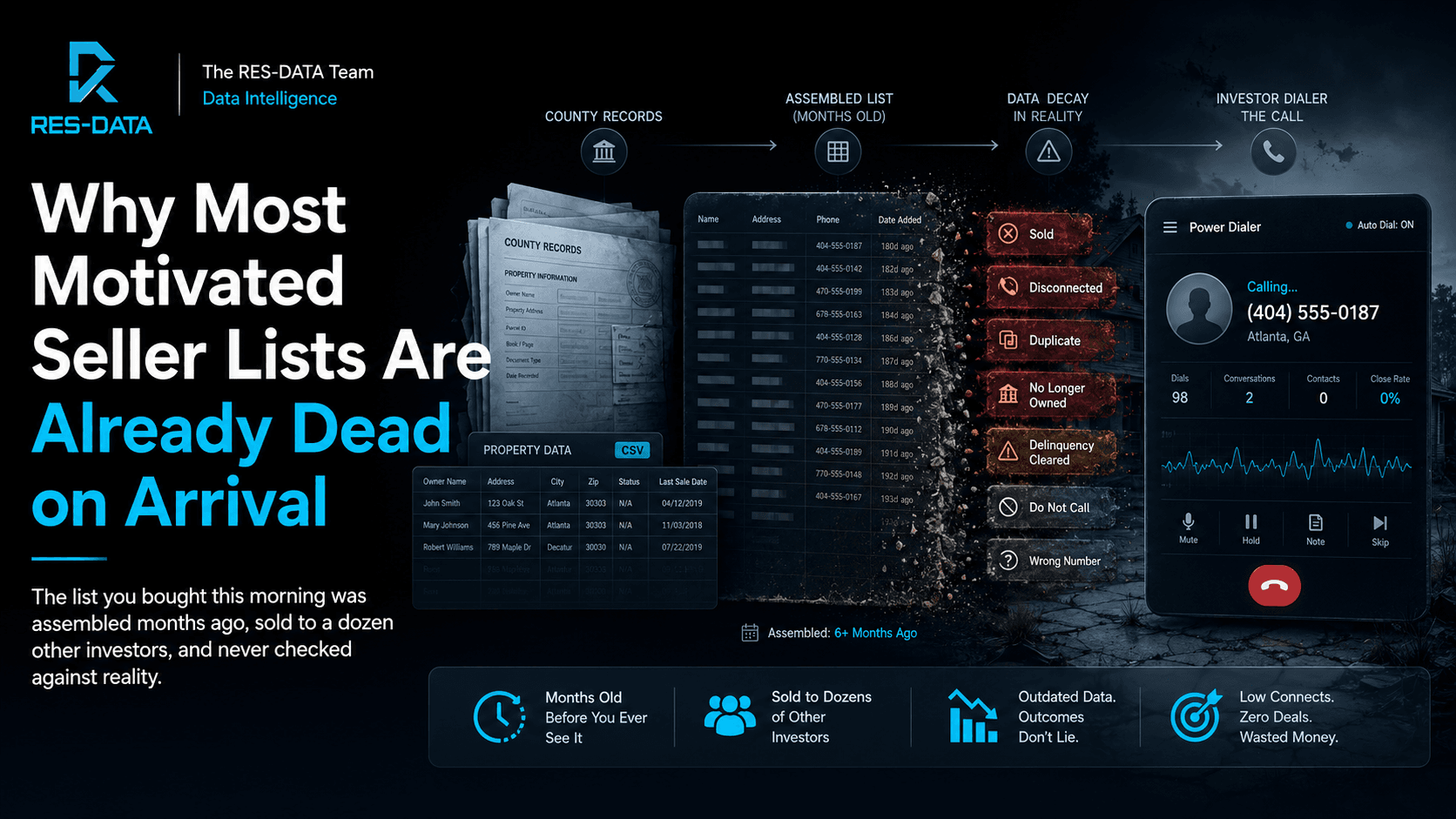
Most seller lists are assembled the same way. A vendor pulls county records, layers on a few public filters — tax delinquency, absentee ownership, probate, code violations — and exports a CSV. That export is accurate at the moment it is created and starts decaying immediately.
By the time a typical list reaches an investor it has been through weeks of that decay, and nothing in the file tells you which rows are still true. A record that says "absentee owner, 14 months delinquent" might describe a property that sold two months ago to somebody who saw the same list you did.
What actually changes between the pull and the call
- Ownership. The deed transferred. You are cold-calling the previous owner about a house they no longer own.
- Status. The delinquency was paid, the probate closed, the violation was cured. The motivation that put them on the list is gone.
- Contact. The number disconnected, ported, or belonged to a relative in the first place.
- Competition. The same record sold to eleven other buyers, and the owner has now been called forty times this month.
Recycled data is the quiet killer
The last item deserves its own section, because it is the one nobody prices in. Static datasets get resold. The same distressed-owner records circulate through the same list vendors, get bundled into new products, and land in the same markets over and over.
From the seller's side this is indistinguishable from harassment, and it does exactly what you would expect: the highest-intent, most-motivated owners become the most hostile, most burned-out people in your file. Your best rows convert worst — not because the targeting was wrong, but because forty other callers got there first.
This is why true deduplication matters more than the word implies. Deduping inside your own upload is trivial. Knowing whether a record has already been worked to death across the market is a different problem, and it requires a provider that tracks distribution rather than just selling access.
Hit rate is not the same as connection rate
Skip tracing vendors advertise hit rates — the share of records where they returned a phone number. That number is easy to inflate, because a wrong number is still a returned number. A 90% hit rate that produces 30% correct numbers is worse than a 70% hit rate that produces 65%.
What you actually care about is the number of conversations per thousand records, and no vendor will quote you that, because it depends on data they do not measure. The only way to know is to instrument it yourself.
How to audit a list before you spend agent hours on it
You do not need a data team to do this. You need one afternoon and a sample.
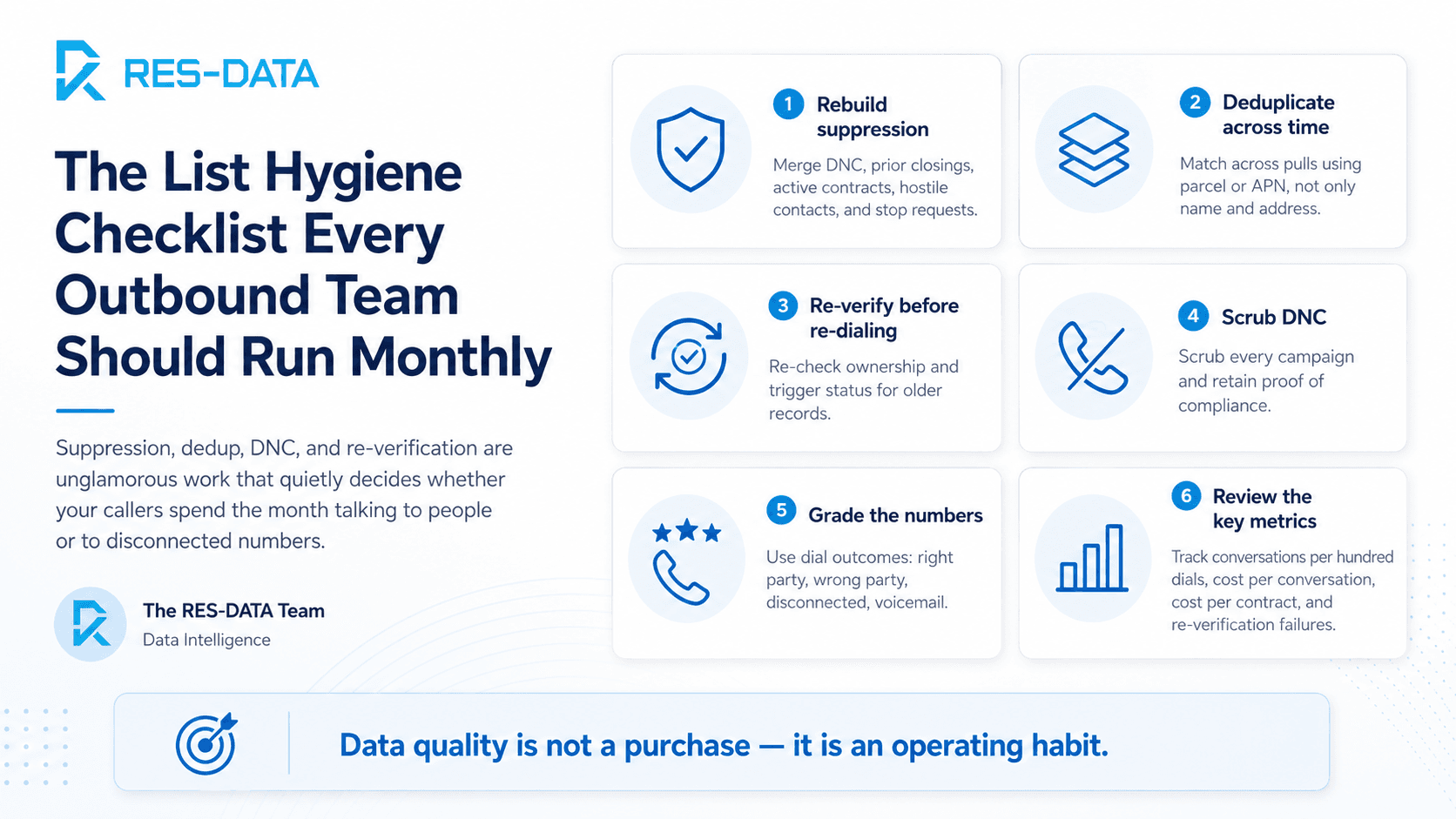
- Pull 100 random rows — random, not the first hundred, which are often sorted by quality.
- Re-verify ownership against the current county record. Anything above a 5% mismatch means the file is old.
- Check the trigger. If a row says tax delinquent, confirm it still is. This is where stale lists fall apart fastest.
- Dial 50 numbers and log outcomes — right party, wrong party, disconnected. That ratio is your real hit rate.
- Cross-reference your CRM. How many of these did you already work in the last 18 months? Overlap above 15% means you are paying for your own history.
Run that on any two providers side by side and the difference is usually obvious within an hour.
What good data looks like instead
The alternative is not a better CSV. It is a different relationship with the data: records that are re-checked on a schedule rather than exported once, suppression that survives across pulls, and a feedback loop where dial outcomes flow back and change what gets surfaced next.
That is the whole reason RES-DATA exists. We monitor list health continuously instead of shipping a snapshot, we track distribution so the same owners are not sold to the entire market, and we let real outreach performance — millions of actual dials — shape what we hand you next.
The measure of a list is not how many rows it has. It is how many conversations it produces per hour of agent time. Once you start tracking that number, most list vendors stop looking cheap.